Lent 2026, Day 9: When Sean Penn got “political.”

Earlier this week, I shared a story about how Orson Welles used his star power to come to the assistance of Sgt. Isaac Woodard, a Black soldier who was horrendously attacked and blinded by a White police officer on his way home from serving in WWII.
Today, we’ll jump forward to the 21 st century. I probably should call this one “When Sean Penn got political again” because Penn has looong been political. From Linda Burstyn at New York:
At 65, Penn is a two-time Oscar winner and a Hollywood elder statesman, an actor who has been called, many times in his career, one of the best in his generation. But he is also an idiosyncratic celebrity. He has flown to Ukraine to encourage soldiers and has bailed New Orleans residents out of floodwaters. To assist with disaster relief after the 2010 earthquake in Haiti, Penn lived for months in a tent, working to rehouse residents and get them medical care. His ad hoc disaster-relief nonprofit, now called CORE, overcame the optics of being a movie star’s pet project to become a respected organization. In 2020, it set up early coronavirus testing sites throughout the country, including a massive pop-up operation at Dodger Stadium that could handle up to 7,500 patients a day.
All the while, Penn has remained something of an ambassadorial thrill seeker, chain-smoking cigarettes and inserting himself into areas where American diplomacy can’t reach.
In 2011, he stepped up big time to help a Brooklyn man wrongfully imprisoned overseas:
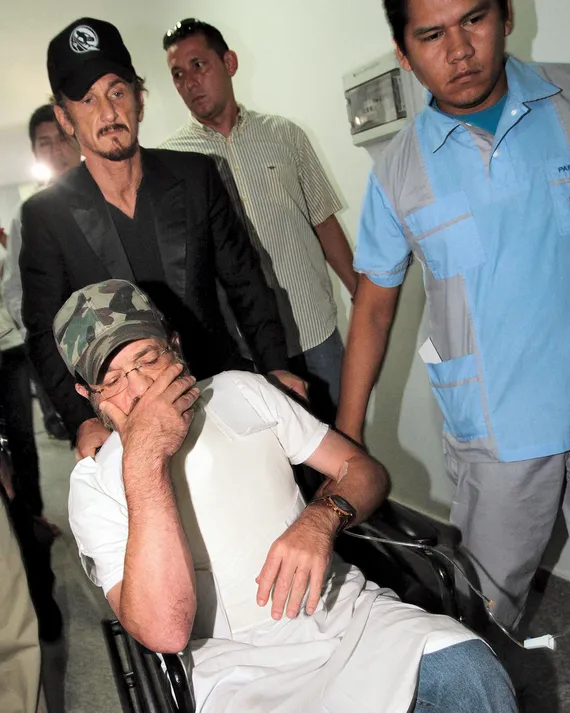
Ostreicher, a then-52-year-old Hasidic businessman who had moved to the country from Brooklyn to manage a rice farm, got stuck there for two and a half years after he was accused of money laundering and criminal organization. His detainment in one of Bolivia’s most brutal prisons had attracted international attention — ABC News’ Nightline had run a segment about his incarceration; it was covered by the New York Times, the BBC, the Associated Press, and the Bolivian and Jewish press. It seemed like he would never get back to the States. Until suddenly, in December 2013, he returned. The Bolivian justice minister claimed Ostreicher had slipped away while out of prison on house arrest. Chaya Gitty Weinberger, Ostreicher’s daughter, told the Times that her father had been “dropped off in Pacific waters,” then released — but only after her uncle had negotiated a ransom. A State Department spokesperson would only confirm to news organizations that Ostreicher was in the United States. What really happened remained a mystery, though there were some cryptic clues: New Jersey representative Chris Smith, who had testified in Congress to advocate for Ostreicher’s freedom, released a statement thanking “Sean Penn for his tireless work to free Jacob.” As it turned out, that tireless work was much more literal than anything previously reported. Over the span of a year, during which he starred in The Secret Life of Walter Mitty, the actor had been making plans to smuggle Ostreicher out of Bolivia by land, by air, or, if necessary, through the heating vents of a hospital.
At a Shabbat lunch in Los Angeles after the Nightline episode came out, a man told Rabbi Boyarsky of the Aleph Institute that he didn’t know Penn but he did know Mark Wahlberg’s bodyguard. Maybe that would help? Which is how the rabbi ended up pleading Ostreicher’s case, first to the bodyguard and then directly to Wahlberg, who agreed to give Penn a call. “The people who talked to Mark Wahlberg knew I had a relationship with Chávez,” says Penn. “What they didn’t know was that around two weeks before, I had gone on a diplomatic visit to Bolivia and had a very simpatico meeting with President Morales himself.” The two had gotten to know each other while Penn was working with Haiti as an ambassador-at-large.
…
After hearing from Wahlberg, Penn spoke to Ungar, who put him in touch with Moore, the ex–FBI agent, who laid out his findings and his theory of Bolivian corruption. Penn checked with contacts in the U.S. State and Treasury departments. Persuaded that Ostreicher’s imprisonment was indeed an injustice, he made plans to fly to La Paz, Bolivia’s administrative capital, immediately.
“My Spanish is nonexistent today, and it was limited at the time,” Penn says. “What I was able to offer the situation was going to be based on having had a good, friendly connection with Morales. It wasn’t going to be very effective on the phone.” He also knew he had to act fast; Ostreicher’s body was starting to fail as a result of his hunger strike.
Morales and Penn kicked a soccer ball around and each made asks: Morales wanted the international community to legalize coca leaves, a product that has many medicinal uses but is also used to make cocaine. Opening legal markets for the leaf could help lift his country out of poverty, Morales said. He asked Penn to essentially become Bolivia’s ambassador for coca leaves before the U.N. Penn let that possibility float as he asked about freeing Ostreicher. “I told Morales, ‘Last thing you want is to have an American die in your prison who’ll later be proven innocent,’” Penn says. Morales gave Penn the use of one of his own military aircraft to fly to Palmasola that night.
“The guy I’d seen on Nightline no longer existed,” Penn says of his first impression of Ostreicher. “He was a stick figure, starving and shaking. I told him, ‘Look, I believe in your innocence and I’ve spoken to President Morales and he believes you’re innocent. I’m going to get you out of here.’”
…Penn decided to change tactics. What if he broke Ostreicher out of the country himself? He says he ran the idea by new U.S. chargé d’affaires Larry Memmott, the embassies of two countries neighboring Bolivia, and a high-ranking State Department official in the region. “And it was indicated, ‘Don’t tell us what you’re doing, but go for it,’” Penn says.
In December 2013, a private investigator using the pseudonym Sylvia Black and her husband, Bill Stewart, led a covert mission to smuggle Jacob Ostreicher out of Bolivia, where he had been under house arrest. The couple, both military veterans with experience in surveillance and rescue operations, agreed to help after learning through CIA contacts that the U.S. State Department would neither assist nor interfere. Although the State Department later denied involvement in his exit from Bolivia, American officials in Peru facilitated his onward travel. Only after boarding the plane did Ostreicher learn he was headed not to New York, but to Los Angeles, where Sean Penn was waiting for him.
When Ostreicher landed, Penn was waiting, and he eventually moved him his Malibu home, offering him safety and hands-on emotional support. Struggling with trauma and heavy drinking, Ostreicher was surrounded by therapists, addiction specialists, and friends like actors Danny Trejo and Robert Downey Jr., who helped watch over him. Downey Jr. even sent a box of designer clothes and a luxury watch with a note encouraging his “comeback,” which deeply moved Ostreicher. Penn also urged him to return to synagogue despite Ostreicher’s hesitation and even accompanied him to services.
Read the whole inspiring story here. Again, a lot of good can come from celebrities getting “political.”